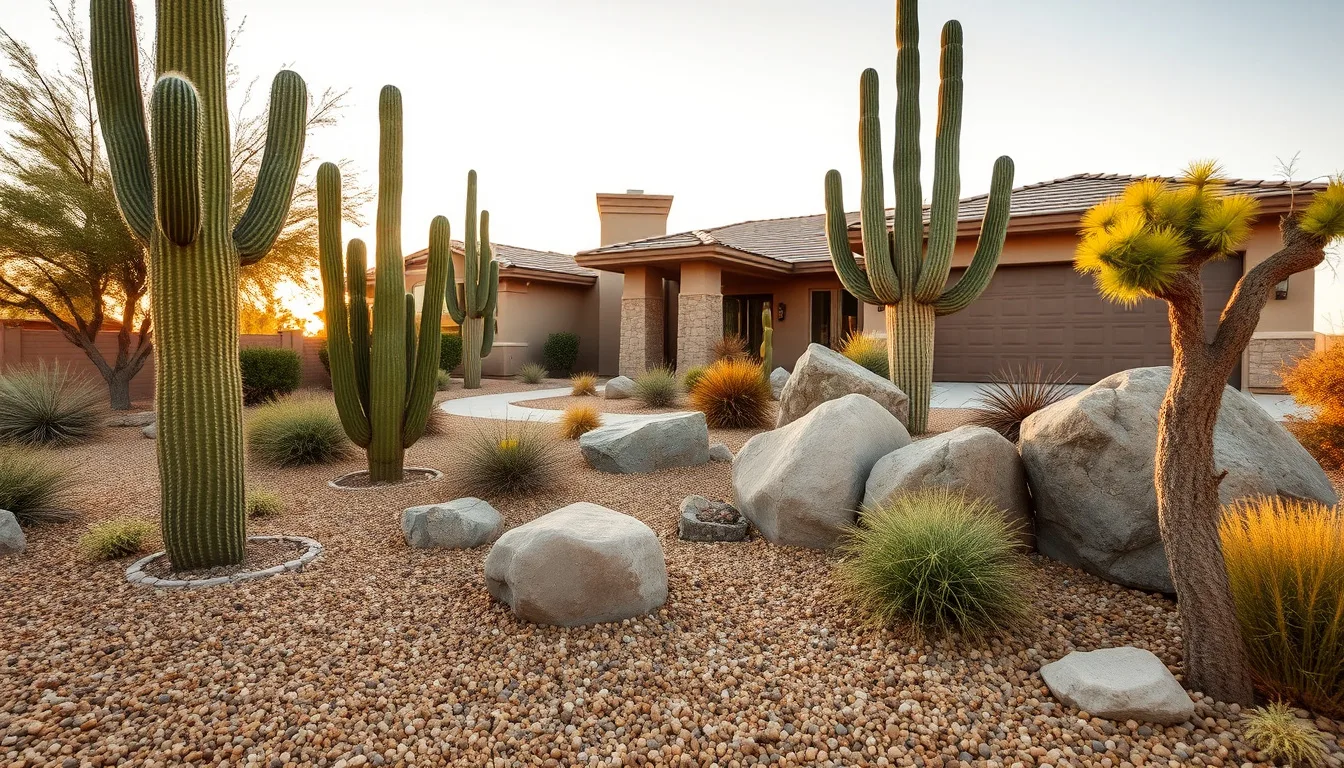
Xeriscape & Desert Landscaping — Maricopa, AZ
Desert Landscaping & Xeriscape Design in Maricopa, AZ — Water-Wise Yards That Still Look Incredible
Xeriscape done right isn't rocks and a cactus in the corner — it's a fully designed, water-budgeted landscape that happens to use a fraction of the water a lawn does.
What Xeriscape Actually Means Today
"Xeriscape" gets a bad reputation from decades of poorly done conversions — a yard stripped of plants and covered in plain gravel, with maybe one struggling cactus near the front door. That's not xeriscape, that's just removing a lawn without replacing it with a real design. Genuine xeriscape is a designed landscape built around water-efficient plants, thoughtful layout, and efficient irrigation — it still has real plant life, real color, real structure, and real shade.
The shift toward xeriscape in Arizona isn't a fringe choice anymore, it's the regional norm. In the City of Phoenix, roughly 80% of single-family properties had majority-grass landscapes in the 1970s; today that figure is under 9%. Arizona's largest water providers collectively serve 3.7 million residents — more than half the state's population — while using just 11% of Arizona's total water, and have kept total drinking-water use roughly flat since 2000 despite adding a million residents.
We design xeriscapes that read as intentional, layered landscapes — not empty lots with rock on top. That's the difference between a yard that saves water and looks unfinished, and one that saves water and looks genuinely better than the lawn it replaced.
The Seven Principles of Xeriscape, Applied to Maricopa
Xeriscape design follows seven core principles — planning and design, soil analysis and improvement, appropriate plant selection, practical turf areas, efficient irrigation, mulch, and appropriate ongoing maintenance. These are the same principles taught by university extension programs, but they mean something specific when applied to Maricopa's low-desert conditions rather than treated as generic national advice.
Planning starts with sun and drainage mapping specific to your lot. Soil analysis in this area almost always has to account for caliche, the hard, poorly-draining calcium-carbonate layer common throughout the low desert, which affects both plant selection and how beds are prepped. Plant selection favors species genuinely adapted to Sonoran Desert heat and monsoon-pattern rainfall, not just "low water" plants pulled from a national list built for a different climate.
Practical turf areas means keeping any real grass small and purposeful rather than defaulting to a full lawn out of habit. Efficient irrigation means drip, not spray, for nearly everything in the design. Mulch — typically decomposed granite or rock in this climate — retains soil moisture and suppresses weeds. And appropriate maintenance means planning for the pruning, weed control, and irrigation checkups xeriscape still needs, since it's lower-maintenance than a lawn, not zero-maintenance.
Real Water Savings, By the Numbers
The water savings from a well-designed xeriscape conversion are substantial and well documented. Converting turf to xeriscape typically cuts outdoor water use by roughly 50%, with figures in the range of 15,000 to over 36,000 gallons saved per 1,000 square feet per year depending on what's being replaced — the largest gap shows up against overseeded winter lawns, where 1,000 square feet of overseeded grass uses roughly 35,000 gallons a year against roughly 15,000 for the same area in xeriscape.
Looked at another way: a Bermuda lawn with winter overseed in the Arizona low desert needs more than 55 inches of irrigation water per year, while the average xeriscape needs less than 18 inches. Landscape irrigation is estimated to account for 60–70% of residential water use in Arizona, which is exactly why the water savings from a xeriscape conversion show up so clearly on a water bill. Lower maintenance costs from reduced mowing, fertilizing, and watering have also been reported to save homeowners an average of roughly $206 a year.
These figures come from the Arizona Municipal Water Users Association and the Arizona Department of Water Resources — the most institutionally credible numbers available for this region, and the ones we point homeowners to when they ask what to actually expect.
- Turf-to-xeriscape conversion: roughly 50% less outdoor water use
- Overseeded lawn: 55+ inches of irrigation/year vs. xeriscape: under 18 inches/year
- Reported average maintenance savings: roughly $206/year vs. turf
A Plant Palette Built for the Low Desert
A xeriscape design lives or dies on plant selection. We build palettes around desert natives and well-adapted ornamentals organized by sun exposure and water zone, so plants that need slightly more establishment water sit together rather than scattered next to plants that want to stay bone-dry. Natives like palo verde, mesquite, and ironwood provide structure and shade; desert marigold, globe mallow, red yucca, agave, and prickly pear provide color, texture, and seasonal interest.
Grouping plants by water need — sometimes called hydrozoning — is what makes efficient drip irrigation possible in the first place, and it's a step that gets skipped in a lot of DIY xeriscape conversions. Getting it right at the design stage is what keeps the finished yard looking layered and intentional instead of sparse.
Does Xeriscaping Affect Resale Value?
This is one of the most common questions we get, and the honest answer is that a well-designed xeriscape is viewed as value-neutral to positive in the Phoenix-metro and West Valley market. Given that roughly 9 in 10 single-family Phoenix-area properties have already moved away from majority-grass yards, a thoughtfully designed xeriscape reads as normal, well-maintained curb appeal — not as a compromise a buyer has to accept.
The key word is "well-designed." A yard that's just gravel with a single struggling plant can hurt curb appeal the same way an unmowed, dying lawn would. A xeriscape built with real plant layering, color, and structure reads the opposite way — as a yard that's been thoughtfully maintained and updated for the climate it's actually in.
HOA Compliance Built Into the Design
Maricopa is heavily HOA-governed, and "will this pass my HOA" is a real and legitimate concern before committing to a xeriscape conversion. Many CC&Rs specify a minimum ground-cover percentage for the visible front yard — often cited around 80–90% — along with an approved or restricted plant list, rules on rock color and size, and tree-placement requirements, commonly around one tree per 50 linear feet of street frontage.
Importantly, many Maricopa-area HOAs still require some form of working irrigation even in a fully xeriscaped yard, specifically to keep desert-adapted plantings alive — this is normally satisfied with an efficient drip system, not a lawn-style sprinkler system. Arizona HOA law has also trended in recent years toward giving homeowners more water-conservation-friendly freedom, expanding what HOAs can and cannot restrict when converting turf to low-water landscaping.
We design with your specific community's guidelines in mind and can help prepare submittal materials for your architectural committee — but because rules vary significantly community to community, we always recommend confirming the specifics with your own HOA's current CC&Rs before finalizing a plan.
The Honest Tradeoffs
Xeriscape isn't free of downsides, and we'd rather tell you upfront than have you discover them later. The main tradeoffs are the upfront conversion cost, a plant-establishment period where newly installed desert plants still need regular watering to root in before they can handle drought conditions, and a real design skill requirement — a xeriscape put in without a plan can end up looking sparse or unfinished.
A professionally designed xeriscape addresses all three directly: the design accounts for establishment-period watering in the irrigation plan from day one, and proper plant density and layering avoid the sparse, half-finished look that gives xeriscape its bad reputation in the first place.
Cost by Yard Size
A xeriscape conversion typically costs less than an equivalent hardscape-heavy project, since it's driven by plant material, groundcover, and irrigation rather than structural work. Exact pricing depends on yard size, how much existing turf needs to be removed, and the plant selection chosen — we quote after an on-site visit rather than guessing over the phone.
If a full conversion isn't the immediate budget, phasing is a genuinely practical option: start with the highest-visibility area (usually the front yard), use decomposed granite or gravel over larger areas initially, and select smaller, younger plant material that fills in over time. We can design a phased plan from the start so later phases build cleanly on the first.
Get Your Xeriscape Estimate
Every xeriscape project starts with a free on-site visit so we can see your yard's sun exposure, soil, and existing landscaping before recommending a design. Call 844-967-5247 or email josh@contractorschoiceagency.com.
We design and install xeriscape landscaping across Maricopa, AZ and nearby communities including Casa Grande, Chandler, Sun Lakes, and the Ak-Chin/Stanfield area.
Desert Landscaping & Xeriscape Design FAQs
Questions before you book
Planning and design, soil analysis/improvement, appropriate plant selection, practical turf areas, efficient irrigation, mulch, and appropriate maintenance — the same framework taught by university extension programs, applied specifically to Maricopa AZ's low-desert conditions.
The main tradeoffs are upfront conversion cost, a plant-establishment period where new desert plants still need regular watering to root in, and a design learning curve if it's done without a plan (poorly designed xeriscape can look sparse) — a professionally designed xeriscape addresses all three.
Xeriscaping is widely viewed as a value-neutral-to-positive feature in the Phoenix-metro/West Valley market given how mainstream low-water landscaping has become — roughly 9 in 10 single-family Phoenix properties have already moved away from majority-grass yards, so a well-designed xeriscape reads as normal, well-maintained curb appeal rather than a compromise.
Phasing the conversion (start with the highest-visibility front yard, expand later), using decomposed granite/gravel groundcover over large hardscape features, and selecting smaller/younger plant material that fills in over time are the most budget-friendly approaches — we can design a phased plan if a full conversion isn't the immediate budget.
Most Maricopa-area HOAs now permit and encourage low-water landscaping, but nearly every community has its own architectural-review process, approved plant lists, and rock rules — and many still require some form of working irrigation to keep desert plantings alive, typically satisfied with an efficient drip system. We design with your specific HOA's guidelines in mind.
Ready for a yard that works with the desert, not against it?
Free on-site estimates for Maricopa and the surrounding West Valley — design, installation, and maintenance built for real Arizona water bills.