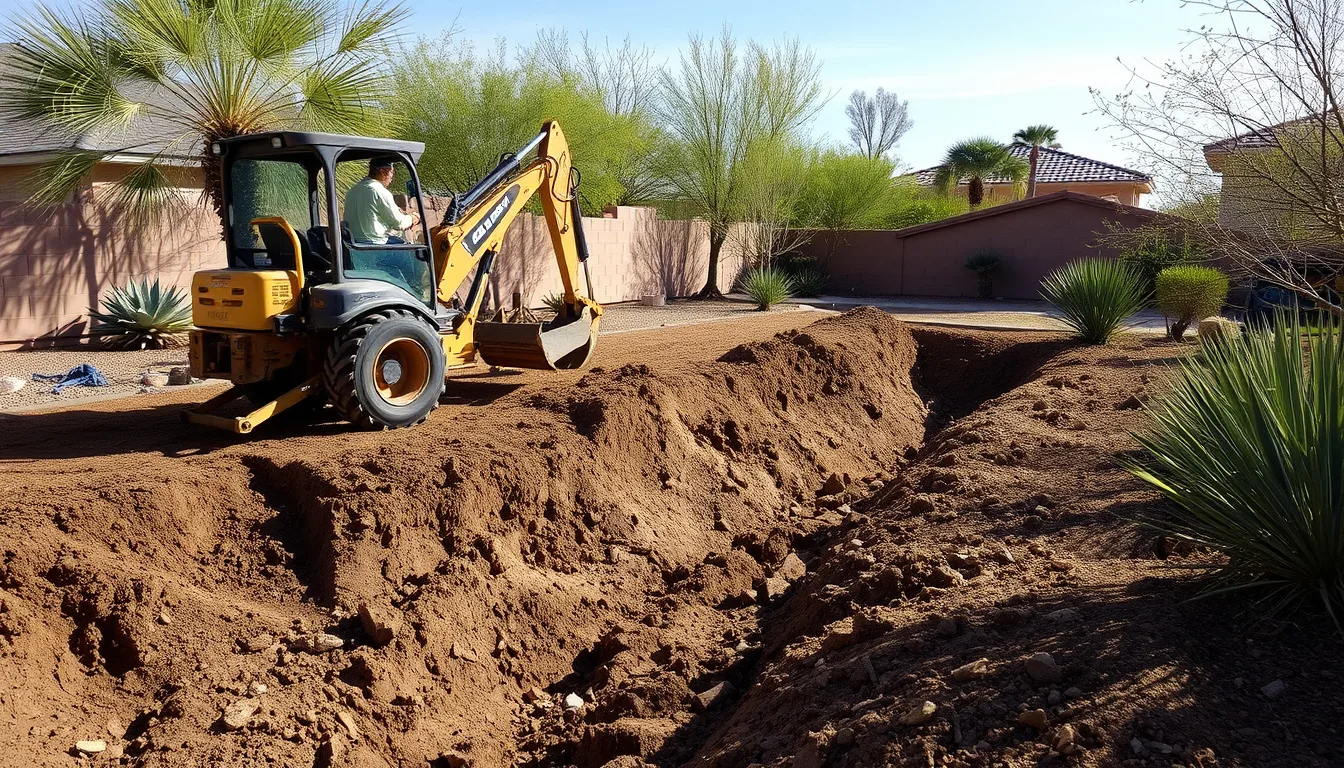
DRAINAGE & GRADING
Drainage & Grading Solutions in Maricopa, AZ — Stop Monsoon Water From Damaging Your Yard and Foundation
Desert yards look dry most of the year, but caliche soil and short, intense monsoon storms make poor drainage a real and common problem — one that's far easier to design out than to fix after erosion or pooling has already started.
Why Desert Yards Are More Flood-Prone Than You'd Expect
It seems counterintuitive — a place that goes months without meaningful rain shouldn't have a drainage problem. But the low desert's drainage risk isn't about total rainfall, it's about how that rain arrives. Arizona's monsoon season, roughly late June through September, brings sudden, short-duration storms that can dump a significant amount of water in a very short window, with storm intensities in the range of about 1.5 inches per hour common during monsoon cells — a rate that overwhelms a yard graded for a slow, steady rain instead of a fast, heavy one.
Making the problem worse, caliche — a hard, calcium-carbonate-cemented soil layer common throughout the low desert, including the Maricopa and broader Pinal County area — drains poorly once water reaches it. A yard can look bone-dry ninety percent of the year and still pool, erode, or push water toward a foundation during a single intense monsoon cell, simply because the soil underneath can't absorb water as fast as the storm delivers it. This is why drainage and grading deserve real engineering attention here, not an afterthought.
Newer construction on Maricopa's growth edges compounds the issue further — a freshly graded lot often has compacted subsoil left over from the building process, which drains even more poorly than undisturbed native ground until it's properly amended or worked around in the landscape design. A yard that seemed fine the first year or two after a home was built can start showing pooling or erosion problems as that compacted layer interacts with a few full monsoon seasons of intense, repeated storms.
Grading and Slope Basics
The foundational principle behind good yard drainage is straightforward: water needs a clear, continuous path away from the house and toward somewhere it can be safely absorbed or directed, without pooling at low points or draining onto a neighboring property along the way. General Arizona desert-hardscape best practice calls for maintaining at least roughly a 2% slope away from the home's foundation — a widely used benchmark across the region for grading work, regardless of exact jurisdiction.
One important caveat: the City of Maricopa sits in Pinal County, not Maricopa County, and Pinal County and the City of Maricopa have their own adopted grading and drainage standards that a homeowner should confirm with the local building or planning department before treating any specific slope percentage as an exact code requirement for a permitted project. The 2%-slope guidance above is sound general engineering practice either way — we design to it as a baseline and adjust for what a specific property's grading review actually requires.
Getting the slope right at the design stage is far cheaper than correcting it later, which is why we check true grade with a level rather than eyeballing it, especially on lots where the original builder grading has settled unevenly over a few years.
French Drains, Dry Wells, and Permeable Surfaces
Grading alone doesn't always solve a drainage problem, especially on a lot with a natural low point, a tight side yard, or caliche close enough to the surface that water can't percolate away on its own. French drains — perforated pipe set in gravel below grade — are one of the most effective tools for intercepting water before it reaches a foundation or pools in a low spot, moving it to a safer discharge point instead. Dry wells serve a similar purpose where there's nowhere convenient to daylight a drain line, giving collected water somewhere to slowly percolate into the soil away from structures.
Permeable pavers and permeable-surface approaches are worth considering anywhere hardscape meets a drainage-sensitive area, since they let a portion of monsoon-intensity rainfall soak through the surface itself rather than sheet-flowing across it all at once. We also use crowned surfaces and small, intentional grade breaks at paver or patio seams so water has somewhere to go at transition points instead of pooling and trapping right where two surfaces meet — a common failure point on hardscape that wasn't planned for drainage from the start.
Fixing Existing Problems vs. Designing It Out From the Start
If a patio, courtyard, or hardscape feature sits at a property's natural low point, drainage pipes and deck drains should be designed and installed before the hardscape surface goes down — retrofitting drainage after pavers or a patio slab are already set is significantly more difficult and expensive than doing it right the first time. This is one of the most common regrets we see on properties where hardscape was installed without a drainage plan: the surface looks great until the first real monsoon storm exposes a pooling or erosion problem nobody accounted for.
For yards with an existing pooling, erosion, or foundation-adjacent water problem, we assess the property to identify whether the fix is primarily a grading correction, a French drain or dry well installation, or a combination of both — and we're upfront if a quick patch won't actually solve the underlying issue versus a more complete regrade. Erosion that's already visible along a fence line, a wash-out under a downspout, or standing water more than a day after a storm are all signs worth addressing before the next monsoon season rather than after.
HOA Drainage Requirements
Maricopa's master-planned, HOA-governed subdivisions frequently include drainage-easement requirements as part of their original community design — retention areas, shared drainage swales, or easements that restrict how a homeowner can regrade near a property line, even for a project intended purely to fix a personal drainage problem. These requirements exist to keep water moving predictably across an entire community rather than letting one property's regrading push water onto a neighbor's lot.
Because drainage-easement rules vary significantly by community and aren't something we can verify from a specific published CC&R document for every subdivision, we recommend confirming your HOA's specific drainage and easement requirements alongside any grading project — we can help identify what your community's architectural committee will want to see and design around those constraints from the start rather than running into them after work has begun. Redirecting water onto a neighboring lot, even accidentally through a well-intentioned regrade, is one of the most common HOA and neighbor disputes we help homeowners avoid.
Drainage & Grading Cost
Cost depends heavily on the scope of the fix — a targeted French drain addressing one problem area is a more modest project than a full-yard regrade, and material and labor costs for drainage infrastructure are generally among the higher line items in any landscape project, alongside hardscape and irrigation work. Dry wells and larger grading corrections scale with the volume of water they need to handle and how much excavation is involved.
We quote drainage and grading work after an on-site assessment of the property's actual low points, soil conditions, and how water currently moves across the lot during a storm — this isn't a project where a phone estimate can responsibly account for what a specific yard needs. When drainage work is bundled with a hardscape or patio project, we can often price the two together for a more efficient overall job than tackling them separately.
Schedule a Free Drainage Assessment
If your yard has pooled, eroded, or pushed water toward your foundation after a monsoon storm — or you're planning a new hardscape feature and want drainage designed in from the start instead of added later — we'll walk the property, check the grade, and put together a fixed-price plan.
Call 844-967-5247 or email josh@contractorschoiceagency.com for a free drainage and grading assessment in Maricopa, AZ and the surrounding area, including Casa Grande, Chandler, Sun Lakes, and the Ak-Chin/Stanfield area.
Drainage & Grading Solutions FAQs
Questions before you book
Making sure drainage and grading are correctly designed before storms hit is the real fix — proper slope away from the home, drains at low points, and secured, well-graded hardscape all matter far more than any after-the-fact patch once a storm has already caused erosion or pooling.
Drainage infrastructure and hardscape typically carry the highest material and labor costs of any landscape project, followed by large-scale grading work, while plant material and groundcover are usually the least expensive line items by comparison. Exact cost depends on how much excavation and pipe or drain installation a specific property needs.
Cost depends heavily on scope — a single French drain addressing one pooling spot is a modest, fixed-price project, while a full-yard regrade or a dry-well installation for a low-lying lot costs more. We provide a fixed price after an on-site assessment of the actual grading and soil conditions, not a phone-quote guess.
A targeted French drain or spot-grading fix is often completed in a day or two, while a full-yard regrade or a project involving dry wells and multiple drain lines typically takes several days to a week or more depending on scope — we schedule and quote larger grading projects individually after inspection.
Ready for a yard that works with the desert, not against it?
Free on-site estimates for Maricopa and the surrounding West Valley — design, installation, and maintenance built for real Arizona water bills.