Monsoon-Ready Hardscape: Drainage Design for Maricopa, AZ Patios & Pavers
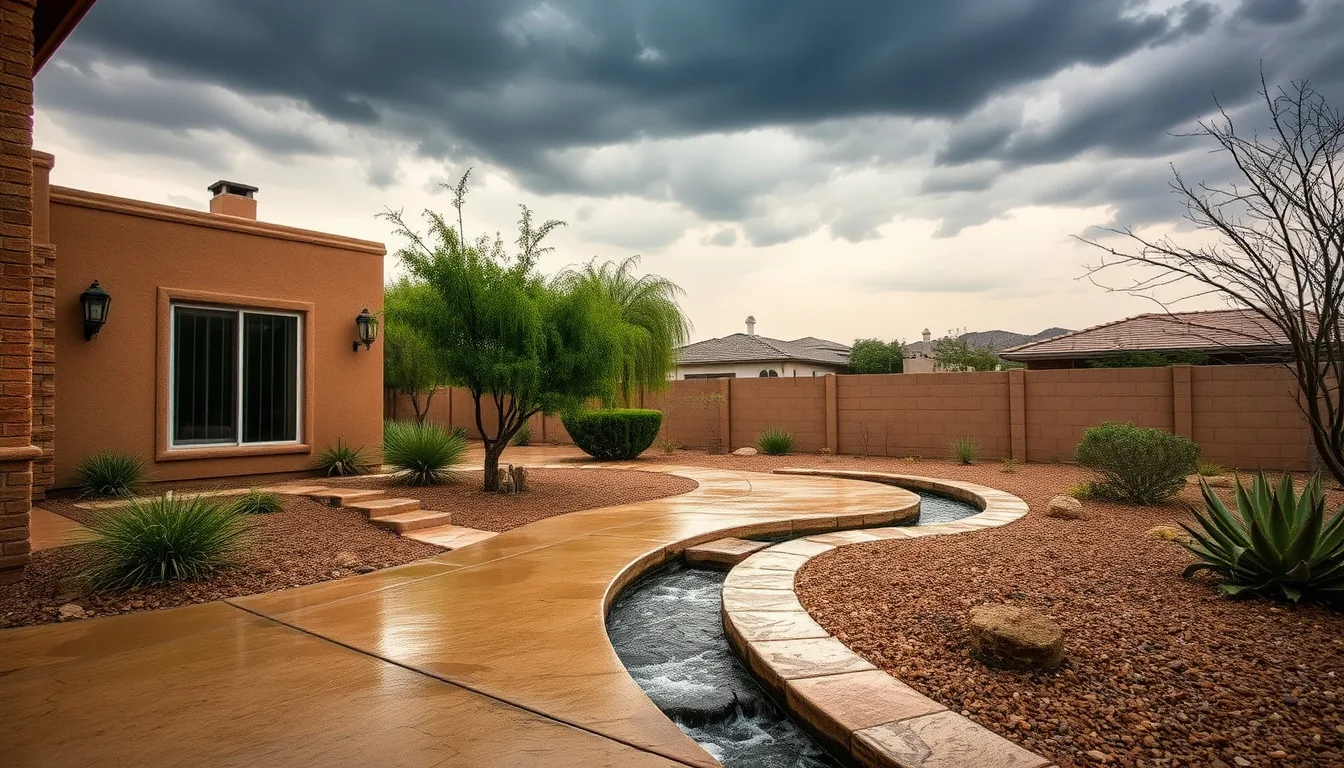
It sounds backwards, but a yard in one of the driest climates in the country can flood faster and harder than a yard in a wet one — and Maricopa, AZ homeowners find this out the moment their first real monsoon storm hits a patio or driveway that wasn't graded correctly. Understanding why takes a little bit of desert soil science, and fixing it takes drainage design that's built in from day one, not patched in afterward.
Why Desert Yards Are Actually Flood-Prone
The core issue isn't rainfall totals — it's rainfall pattern combined with what's underneath the surface. Arizona's monsoon season, roughly late June through September, brings sudden, intense, short-duration rainfall rather than the slow, steady rain that soaks gradually into the ground in wetter climates. A storm cell can drop a significant amount of water in a very short window, and desert soil simply isn't built to absorb that kind of intensity quickly.
That's made worse by caliche — a hard, calcium-carbonate-cemented soil layer common throughout the low desert, including the Maricopa and broader Pinal County area. Caliche drains poorly, sometimes acting almost like a shelf of rock just below the surface, and it's a frequent, often unexpected cause of pooling and erosion around new hardscape when it isn't accounted for during grading and base preparation. A patio or driveway that looks perfectly level and solid on a dry October afternoon can reveal a caliche layer trapping water right underneath it the first time a real monsoon cell rolls through.
Put those two factors together — intense, fast rainfall and a soil layer that resists absorbing it — and you get a genuinely flood- and pooling-prone yard, despite a climate that spends most of the year bone dry. It's a counterintuitive risk, but it's a real and well-understood one in desert hardscape work.
Grading and Slope Fundamentals
The starting point for any monsoon-resistant hardscape design is grading — the shape and slope of the ground itself, before a single paver goes down. General Arizona desert hardscape guidance calls for maintaining a minimum slope of roughly 2% away from the home's foundation, and designing so that water is never directed in a concentrated flow onto a neighboring property. Storm intensities in the range of 1.5 inches per hour are common during monsoon cells, and a hardscape design that can handle that kind of short, intense burst is designing for the real conditions this region actually produces, not a generic national rainfall assumption.
One honest caveat worth flagging here: a lot of the specific slope and drainage-code figures found in general research reference "Maricopa County" drainage rules. The City of Maricopa is in Pinal County, not Maricopa County — a genuinely confusing naming overlap — and Pinal County and the City of Maricopa have their own adopted grading and drainage standards that are worth confirming directly with the City's building and planning department before treating any specific code section as gospel for a permitted project. The 2%-slope and monsoon-intensity engineering guidance above is sound general Arizona desert-hardscape best practice regardless of which county's exact code applies, and it's what we design to as a baseline — but for anything requiring a permit, we recommend confirming the exact local requirement rather than assuming a county-line figure applies word for word.
French Drains, Dry Wells, and Permeable Pavers
Grading alone often isn't enough on its own, especially on a lot with any natural low point or a caliche layer close to the surface. A few proven approaches handle the gap between "sloped correctly" and "actually keeps water out of trouble spots" during a real monsoon storm:
- French drains — a buried perforated pipe surrounded by gravel — collect water at a problem area and carry it to a safer discharge point instead of letting it sit and pool.
- Dry wells give collected water somewhere to go on a lot without an easy surface discharge point, holding and slowly releasing it into the soil below rather than letting it sit at grade near a patio or foundation.
- Permeable pavers let water pass through the paved surface itself and into a properly prepared base below, rather than shedding all of it across the surface toward a single low point — a genuinely useful approach for monsoon-intensity storms specifically.
- Crowned surfaces — a patio or walkway shaped slightly higher in the middle than at the edges — move water off to both sides instead of letting it travel the full length of a flat surface toward one collection point.
Which combination makes sense depends on the yard's actual grade, where the low points are, and what's already built nearby — which is exactly why a site visit matters more than a generic drainage template. A yard with a caliche layer close to the surface, for example, may need a dry well or French drain paired with the grading itself, since the caliche limits how much water the surrounding soil can simply absorb on its own even with a well-graded slope leading to it.
Designing Drainage In From Day One vs. Retrofitting
This is the single most important piece of planning advice in this guide: if a patio or courtyard sits at a natural low point in the yard, drainage pipes or deck drains need to be designed and installed before the hardscape surface goes down, not after. Retrofitting drainage underneath an existing patio or paver surface is significantly more difficult and more expensive than building it in from the start — it often means pulling up some or all of the existing hardscape to get a drain line where it needs to go.
This is also where a lot of well-intentioned DIY and budget hardscape projects run into trouble. It's easy to grade and lay pavers so the surface looks flat and finished, and easy to miss that a low spot exists at all until the first real storm sends water pooling exactly where the patio furniture sits. Getting the drainage plan right at the design stage — before the base material and pavers are ordered — is what actually prevents that outcome, rather than discovering it the hard way in August.
The same logic applies to any hardscape addition next to an existing structure — a new paver walkway poured up against an older patio, or a driveway extension tied into an existing slab. Each new section needs to be graded to work with what's already there, not just leveled on its own, or the seam between old and new hardscape becomes exactly the kind of low point that collects water during the next storm. This is one of the most common reasons a "simple" hardscape addition ends up needing more drainage planning than the original project did.
Grade Breaks at Paver and Patio Seams
One detail that's easy to overlook but matters a lot in practice: a small, intentional grade break at the seam where a paver patio meets a different surface — a walkway, a driveway, the edge of a lawn or planting bed — so water doesn't pool and trap right at that transition line. Without it, seams and transitions become the first place water collects during a storm, even on an otherwise well-graded patio, simply because the two surfaces meet at slightly different elevations with nowhere for the water at that exact line to go. It's a small design detail, but it's one of the most common places we find standing water on hardscape that otherwise looks properly built.
Warning Signs Your Yard Already Has a Drainage Problem
Some drainage issues show up clearly during a storm; others only reveal themselves afterward, once the water is gone and the damage is already done. Watch for:
- Standing water that takes more than a few hours to disappear after a monsoon storm passes, especially near a patio, walkway, or foundation
- Visible erosion channels or bare, washed-out soil running from a roofline, downspout, or paved area toward a low point in the yard
- Cracking, shifting, or unevenness in existing pavers or a patio slab, which can indicate water is undermining the base material underneath
- Water pooling directly against the foundation rather than moving away from it, which is one of the more serious signs worth addressing quickly
- A consistently soggy or slow-draining area even a day or more after a storm, often a sign of a caliche layer trapping water close to the surface
Any of these are worth a real evaluation before the next monsoon season, rather than after a storm has already caused erosion, pooling, or foundation-adjacent damage that's more expensive to fix than to prevent.
Get Ahead of Monsoon Season
Whether you're planning a new patio, dealing with a hardscape project that already has a pooling problem, or just want an existing yard evaluated before the next storm season, drainage is the part of a desert hardscape project that's far cheaper to design correctly up front than to fix afterward. We build grading, slope, and drainage into every hardscape project from the first sketch — not as an afterthought once the pavers are already down.
Call 844-967-5247 for a free estimate on a new hardscape project or a drainage evaluation of your existing yard.
Ready for a free estimate?
On-site estimates for Maricopa and the West Valley — water-wise design, honest pricing.